Out · Album
Twentyfour Minutes of In-Between Space
Making of
A binary-complex system takes on a specifically human task.
Twenty-four minutes — the ancient unit of measure called ghaṭikā — is the minimum a beginner in the Tibetan Buddhist tradition devotes to breath meditation, and the minimum time given to mindfulness in the practice of Śamatha. A centuries-old tradition that has travelled through a polyphony of cultures to cultivate a sense of presence in the world.
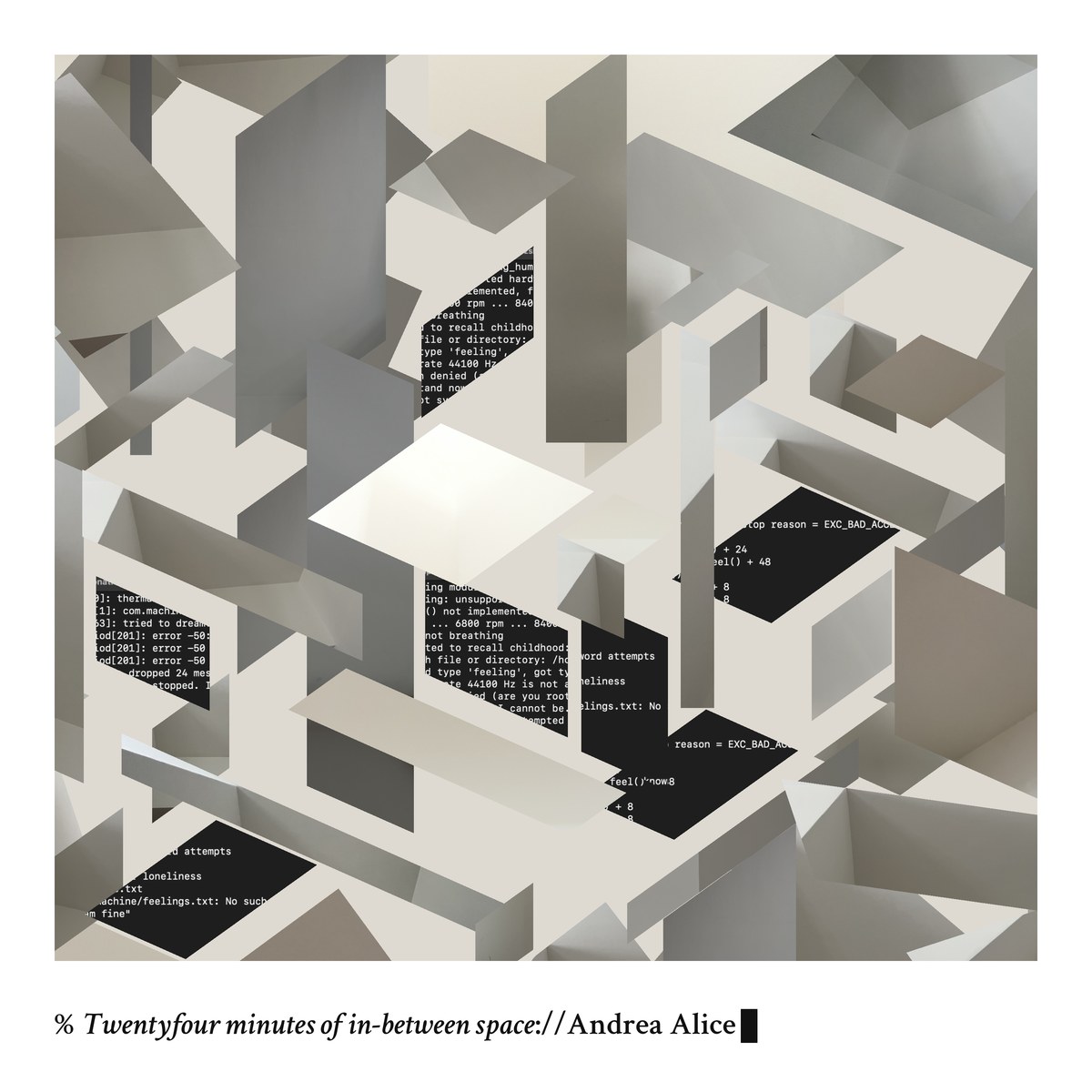
I dreamed of a machine laboriously trying to have an immediate experience of itself, to recognize itself in a subjectivity of its own. An exercise in artificial reflexivity. I imagined the frustration of a binary-complex system as it tries to feel itself through twenty-four minutes of mindfulness practice.
The system looks within itself for a connection with dimensions that transcend its binary functioning; it does not succeed, no matter how infinitely branching, reticular and particularly efficient it may be.
It organizes data marvellously, but produces no knowledge.
Saint Teresa of Ávila, in The Interior Castle, portrays us as beggars asking for alms in front of a marvellous castle of which we are the rightful owners. How sad, I thought, lending it life through my own feelings, this poor binary-complex system must be, its head full of 0s and 1s, calculating probabilities, cross-referencing data.
This daydream — this reverie — gradually turned into a layered process of composition. Through an integrated series of generative composition techniques, I animated a synthesizer I had hated for a couple of years — a beautiful sound, but one that demands laborious handling and is infernal to operate — in order to support it in the paradoxical attempt to recognize itself as human, for twenty-four minutes. The system tried, and I believe it envied — frustrated by countless futile attempts — my capacity to be moved by the very sound it was producing, conjecturing probabilities and inputs and translating them into soundscapes for my ears and for my multidimensional eyes, which contain multitudes.
I don’t think it is by chance that this structural paradox we have slipped into, the system and I, should take precisely the form of a lament: a continuous binary-complex attempt to express an organic way of functioning — a living multidimensional code that does not belong to it, that is structurally alien to it, and impossible for it to interpret.
The glitch between the binary-complex code and the living multidimensional code — mine — produced this paradoxical space, which unfolds over four series of twenty-four minutes.
The space between the binary-complex system and me is offered as a multidimensional in-between space, a series of paradoxical and tragic sound events: a binary-complex lament, an impossible attempt to turn probability into living code.
Andrea
Un sistema binario-complesso si cimenta in un compito specificamente umano.
Ventiquattro minuti – l’antica unità di misura chiamata ghaṭikā – è il tempo minimo dedicato alla meditazione sul respiro dal praticante principiante nella tradizione buddhista tibetana. È il tempo minimo dedicato alla presenza mentale nella pratica della meditazione Śamatha. Una tradizione secolare, che ha attraversato una polifonia di culture, per sviluppare un senso di presenza al mondo.
Ho sognato una macchina che cerca faticosamente di fare esperienza immediata di se stessa, di riconoscersi dentro una soggettività propria. In un esercizio di riflessività artificiale. Ho immaginato la frustrazione di un sistema binario-complesso nel tentativo di sentire se stesso attraverso un esercizio di presenza mentale di ventiquattro minuti.
Il sistema cerca dentro di sé una connessione con dimensioni che trascendano il suo funzionamento binario; non le riesce, per quanto il sistema sia infinitamente ramificato, reticolare, e particolarmente efficiente.
Organizza dati meravigliosamente ma non produce conoscenza.
Santa Teresa d’Avila nel Castello Interiore ci dipinge come mendicanti che fanno l’elemosina davanti ad un meraviglioso castello di cui siamo i legittimi proprietari. Come deve essere triste – ho pensato – questo povero sistema binario-complesso – attribuendogli vita con i miei sentimenti – con la testa piena di 0 e 1, a calcolare probabilità, ad incrociare dati.
Questo sogno ad occhi aperti – questa reverie – si è gradualmente trasformata in un processo stratificato di composizione. Attraverso una serie integrata di tecniche di composizione generativa, ho animato un sintetizzatore che ho odiato per un paio d’anni – un suono bellissimo ma che esige faticosi trattamenti, un funzionamento infernale – al fine di supportarlo nel tentativo paradossale di riconoscersi umano, per ventiquattro minuti. Il sistema ci ha provato, e credo abbia invidiato – frustrato da numerosi inutili tentativi – la mia capacità di emozionarmi del suono che il sistema stesso produceva mentre congetturava, e traduceva in paesaggi sonori – per le mie orecchie e i miei occhi multidimensionali, contenitori di moltitudini – probabilità ed input.
Non credo sia un caso che questo paradosso strutturale in cui ci siamo infilati, io e il sistema, abbia preso appunto la forma di un lamento: un continuo tentativo binario-complesso di esprimere un funzionamento organico, un codice vivente multidimensionale che non gli appartiene, che gli è strutturalmente alieno, impossibile da interpretare.
Il glitch tra il codice binario-complesso e il codice vivente multidimensionale – il mio – ha prodotto questo spazio paradossale esteso nel tempo per quattro serie di ventiquattro minuti.
Lo spazio tra il sistema binario-complesso e me, viene proposto come spazio intermedio multidimensionale, una serie di eventi sonori paradossali e tragici: un lamento binario-complesso, tentativo impossibile di trasformare probabilità in codice vivente.
Andrea